John and Mary Cavendish’s marital estrangement
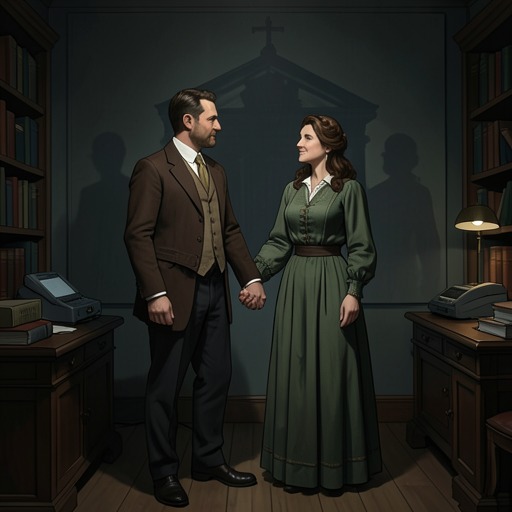
The Mysterious Affair at StylesJohn and Mary Cavendish’s marital estrangement is a private relationship crisis that becomes entangled with the public murder case at Styles Court. Mary entered the marriage candidly without being in love; John knew it, and their gradual withdrawal from one another left affection alive but unspoken. Poirot later judged that the danger of John’s trial brought the pair back together, turning the case into an unlikely occasion for reconciliation.
Origins of the Marriage
Mary explains that her aunts regarded the match as advantageous, but insists that this consideration did not determine her choice. John offered escape from the monotony of her life. She told him plainly that she liked him and hoped her feelings might deepen, but that she was not, in the usual sense, in love with him. John said this was enough, and they married. Their union therefore began not with concealed expectations on Mary’s part, but with an acknowledged difference between affection and romantic love.
Mary believes John cared for her at first. Yet she describes them as poorly matched and says they drifted apart almost immediately. In her account, John tired of her soon; she acknowledges that this is painful to her pride, while adding that it no longer matters because they have reached a parting of the ways. The marriage’s early honesty did not prevent later hurt: it left both with knowledge of the original imbalance, but not necessarily a shared understanding of what their feelings had become.
Separation at Styles
The estrangement has become concrete by the time Mary speaks with Arthur Hastings. She tells him that she will not remain at Styles, distinguishing her own departure from John’s choice: he may continue to live there, but she will not. The decision gives their emotional distance a practical and domestic consequence. The household and estate that frame the murder investigation will no longer be the setting of their shared life, at least from Mary’s perspective at this point.
Their situation is sharpened by the Cavendish family’s inheritance arrangements. Emily Inglethorp’s will from the previous August left her entire fortune to John, while provisions in his father’s will meant that Lawrence Cavendish would receive a considerable sum when Emily died. John presents this distribution as fair because he would have to maintain Styles. But Emily’s remarriage automatically revoked that earlier will under English law. These arrangements help explain the financial and legal pressures surrounding the family; they do not, by themselves, account for the emotional separation between John and Mary.
The Trial and the Misunderstanding
The prosecution depicts John as a profligate and spendthrift man near the end of his financial resources, living with Mary at Styles in comfort because of Emily’s generosity. It alleges that Emily confronted him over an intrigue with Mrs. Raikes on the afternoon before her death, and that the quarrel led to a new will. This courtroom account makes the troubled marriage part of the case’s public portrait of John, linking domestic conflict and financial dependence to the prosecution’s accusation. It is an argument presented by counsel, not a neutral account of the couple’s private feelings.
At John’s trial, his defence contests the prosecution’s account of the quarrel. It argues that he had been told there was a violent disagreement between Emily and Alfred Inglethorp and had no reason to think that anyone could have mistaken his voice for Alfred’s; he assumed there had been two quarrels. The defence also states that John, formerly a barrister, knew Emily’s earlier will in Alfred’s favour had been revoked by her remarriage. The legal narrative thus places the family’s misunderstandings beside the marital one: what was heard and inferred about a quarrel helped shape suspicion, while the marriage’s underlying distance remained a separate, less visible problem.
Reconciliation and Narrative Significance
After the danger of the trial has passed, Poirot tells Hastings that John still loved Mary and that he believed her love for John was mutual. In his interpretation, John had understood that she married him without love and, being sensitive, did not press himself upon her when he thought she did not want him. As John withdrew, Mary’s love awakened; nevertheless, both were unusually proud, and their pride kept them apart. Poirot also connects their respective entanglements—with Mrs. Raikes on John’s side and Dr. Bauerstein on Mary’s—to the period of estrangement, though the evidence does not make either relationship a simple substitute for the marriage.
Poirot says he could have cleared John before the trial, but delayed doing so while working toward the exposure of the real criminals. He ultimately chose what he calls a woman’s happiness, believing that only the great danger they had faced could reunite the proud couple. His explanation recasts the trial’s emotional consequence: the proceedings threatened to separate John and Mary permanently, yet that shared danger also broke through the reserve that had kept them apart.
The reconciliation is confirmed in a remembered scene. Mary, white and exhausted on a sofa, listens for news; when the bell sounds below, she starts up. Poirot opens the door, meets her anxious gaze, and tells her that he has brought John back. He then stands aside as John catches his wife in his arms. The estrangement ends not through a newly negotiated account of their marriage, but through reunion after peril. For the novel’s conclusion, the episode sets private happiness against the formal demands of criminal justice: Poirot’s decision to let the case reach its decisive stage is presented as the means by which the two proud spouses find their way back to one another.